Be yourself; Everyone else is already taken.
— Oscar Wilde.
This is the first post on my new blog. I’m just getting this new blog going, so stay tuned for more. Subscribe below to get notified when I post new updates.
Be yourself; Everyone else is already taken.
— Oscar Wilde.
This is the first post on my new blog. I’m just getting this new blog going, so stay tuned for more. Subscribe below to get notified when I post new updates.
George Takai’s graphic novel was a page turning read about the internment of Japanese Americans during World War Two. I feel that presenting history through a graphic novel is an effective and meaningful way to have the facts of the past sink in with the reader. I would like to see more historical events being told through graphic novels.
I think the main message Takai was trying to get through, with his story, was the importance in protesting injustice in any way a person can. Like with his father, sometimes protesting comes in the ways of organizing, volunteering, and staying true to one’s own convictions. As Takai illustrated on page 123, staying true to one’s convictions can often times be one of the most effective ways to protest against injustice. Contrariwise to this point, Takai also illustrated on page 134 how some of the interned Japanese chose to protest, which was acting out of anger and against their normal sets of convictions. However, Takai seems to suggest that there is no right or wrong in these peoples forms of protest. I believe he sums it up best on page 203, when he speaks about justice being the American ideology, and that “History can’t be a sword to justify injustice or a shield against progress…”
Overall, I believe Taki’s graphic novel was an effective and profound way to tell the story of the interned Japanese. It is a story in history that we can all learn from and should continue to discuss and remember. I do not necessarily agree with Takai, though, on page 197. He seems to hint that the 2018 president (Trump) is responsible for “interning” Illegal immigrants. Unless I am wrong ( and I often am), the act of detaining in cages, ICE detained illegal immigrants, was a policy started by the Clinton administration. I also know that the two other presidents after Clinton kept this policy in place. I also know that the current president signed an executive order stopping the separation of children and their parents (although you will be hard pressed to find that information on 88% of the covered news media’s). I guess, I am just upset that Takai used this very real and very sad story, to push a political agenda that is historically and wildly biased and inaccurate. Why not show (on page 197), a picture of the same caged immigrants (who were not citizens like the 1940’s Japanese, so it is wildly uncorrelatable) during the years 1997-2016? He could have picked any of those years because the same thing was being done. It was on this page that I realized his novel may have been less about telling a story that we can all learn from and more about serving as a current political rhetoric machine.
I apologize for the rant, I am not what you would consider a supporter of this or any president, really. I am not associated with any political party either. I just hate to see when people try and push an agenda, and use something that was very real and very unfortunate to give their narratives weight. 90% of Takai’s novel was fun to read and I really gained a deep perspective and grouping of insights from his work. The last 10%, when he tried to drive home his conclusion, was very political and I could see right through it.
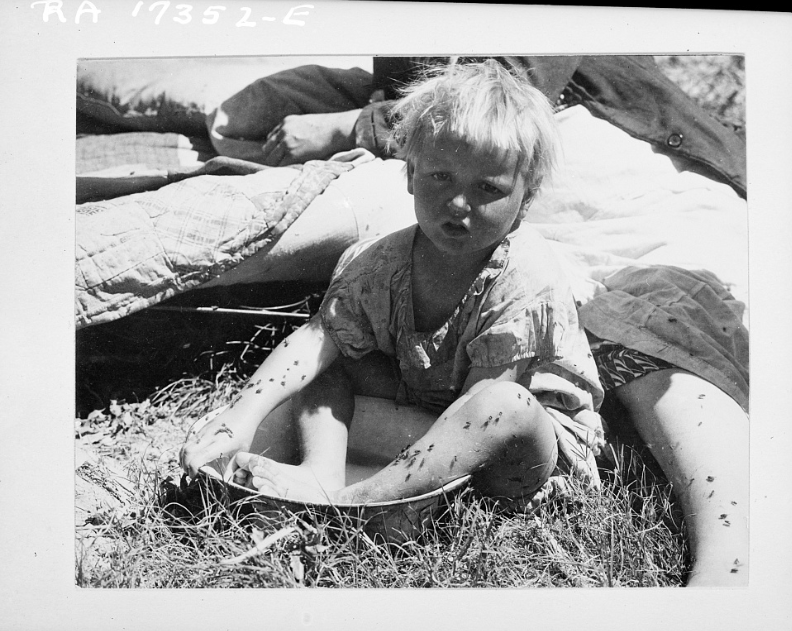
The Picture I chose to discuss for this weeks forum was taken by none other than Dorothea Lange and is titled “Cleanliness” (See attached picture). This photograph shows the misery and desperation of a child, sitting next to a grownup laying down on the grass. Both the grownup and the child’s limbs are covered with flies, and the child appears to be soaking its legs in a bed pan. It is uncertain whether the child is a boy or a girl, as the style of the child’s hair could suggest either. Additionally, the child is wearing what appears to be a girls shirt (flowing frock). However, given the era and the knowledge that many families of the time lacked the funds for new or gender appropriate clothing for all of their children, it is difficult to ascertain the gender of the pictured child.
The reason this photo stood out to me is because I am a father of two young girls. Having a soft spot for children, I was immediately saddened to see such a young child sitting on the dry grass with flies covering their body. To see the leg of the grownup covered in flies, and making no effort to try and swat them away, suggests that the people in this photo have given up hope completely. What’s more, the look of misery and discomfort on the child’s face made me want to help (even though this picture was taken well before I was born). I imagine that a photo such as this would be highly effective towards garnishing support from the American people for New Deal programs. To see such a small child being negatively affected by the depression would be a powerful image for any to want to send financial support. Also, this image would absolutely necessitate the need for government programs to try and get the parents of this child back to work. Being that many of the Americans who would have viewed this photo were likely parents themselves, this photograph would have resonated with them. Perhaps seeing this would have sparked a sense of fear that this situation could happen to them and their children if action by the government was not taken.
Other observations from this photo found that both the grownup and the child are outside. The grass, as mentioned before, appears to be dry and the bright sunlight in the picture suggests that it could be hot outside (warm enough for insects). Since the grownup is lying down in the grass, it is inferred that is where the two sleep, which also suggests a lack of housing. The water in the bedpan down not appear to be clean, so it may suggest that the child’s access to clean drinking water may not be prevalent. Overall, this photo conveys a message of total desperation and misery. If Lange was determined to show the American people the severity of the depression, she absolutely captured it with this image.
Using the San Diego Union Tribune, I attempted to find similarities between the reporting on the presidential races of 1932 and the current race of 2020. I ultimately focused my search towards the parties and their choosing of front-runners. Initially, though, I thought I’d research what the reporting looked like on the coverage of taxation and then immigration. As it turns out, taxation was indeed widely covered in 1932, yet it didn’t appear to have much in common with what the Tribune was reporting today. Likewise, the coverage of immigration in 1932 was more about the arrest and deportation of small handfuls of undocumented workers. The issue of immigration today is more widespread and appears to have taken on a whole new meaning.
Upon an extensive and lengthy review of several issues of the Tribune, I stumbled on an article written on March 17, 1932. The article is found on page 4 and it is titled: “No Man– or Plan”. Effectively, this article discussed the Democratic party’s uncertainty on choosing a front-runner. This was evident from the author writing: “There is, however, no semblance of a unified plan in the Democratic program, unless a studied effort to avoid positive commitment in any direction could be called a plan” (SDUT, 1932 p.4). The author then went on to say: “No, unless a miracle happens, we just can’t see any ‘Sweeping Democratic Victory’ in this Republican state [California]” (SDUT, 1932 p.4). It would appear that even in 1932, when faced with many national and international issues, the party appeared to be unable to unite around any one issue.
Looking to find a current report to compare this issue to today, I was quick to find an article written on October 28, 2019, titled: “Growing Uncertainty looms over Democrats’ 2020 Primary”. In this article, the author describes how the Democratic candidates are all over the place on the political spectrum. What’s more, the author points to how the amount of Democratic candidates running is hurting the party’s ability to garnish consolidated public support. The author wrote: “The historically large field, while in part of measure of the desire to oust the incumbent president, has also made it harder for the top contenders to forge a more focused contest” (SDUT, 2019). Sizing up candidates like Elizabeth Warren and Bernie Sanders, and then Biden and Steyer, the author mentions how these political warriors are too diverse in their economic and foreign policy plans. The most poignant piece of evidence, which led me to immediately see the similarities between the 1932 race and todays was when the author cited the opinions of the voters. The author cited a voter by writing: “‘I didn’t realize the amount of people that we had as candidates!'” Borglum said. “‘So many people have a plan. Is anyone really right?'” (SDUT, 2019).
It would appear that history continues to show the cyclical nature of political campaigns when there are so many issues in the world. Additionally, a rallied and large scaled effort to get rid of the incumbent seems to draw out a large number of candidates hoping for the job. Unfortunately, though, the result could lead to too much diversity in presidential plans, thus creating too much division among the voters. This situation has the ability to cripple the chances of a party’s chances at gaining sufficient support to win the election.
Upon reading this book, I was dumbfounded by how I had never heard of this event throughout my years of schooling. Furthermore, I was shocked to hear about the example of a lynching by the “Washington Eagle” and how it described the barbaric happenings during its course. I am sickened to hear how cruel and hateful humans can be towards each other. What’s worse, is how we can be that way when it deals with something as natural and unavoidable as race. I guess what this shows though, is how little we’ve grown as a species since our time on this earth.
I will suggest the following as to how we shall not only learn from this event, but make good on it as well. Since this event was caused by systemic government policy, law enforcement’s dereliction of duty, and media misrepresentation, the redress for the massacre of African Americans in Tulsa should be:
1. Any living survivors should be compensated for theirs, or their relatives losses in property, life, or grievances, which was a result from the riots in Tulsa of 1921. The compensation should be equal to the amount lost (taken in to consideration for inflation), and should be paid for by the state, since this was a failure of the state. For consideration of loss of life, the state will pay a lump sum to the family name an amount equal to the years of employment lost due to the age of the departed; accounting for 65 years of age being the time no longer employable.
2. All efforts should be made to exhume the remains of the suspected mass graves in Tulsa, in an effort to properly lay to rest all those entombed.
3. If not done so already, all Gun free zones should be abolished and the state should adopt a “Shall Issue” Concealed Carry Weapons (CCW), permit policy. As the Tulsa issue targeted indiscriminately people of color. The state should harbor a policy that allows all of its citizens to protect themselves in time of peril.
4. The state would do well to introduce this event into public school systems and community affairs. Learning about the past helps us to avoid repeat occurrences. Initiating a remembrance day, or something of that nature, will assist the community in feeling remorse for our past actions and thereby taking steps to ensure events like these do not happen again.
The Tulsa riots spawned from the country’s attitude towards race during the time period. Racism was a thing. It was embedded in our local communities, our military, and our federal policies. It’s what people were born into. Looking through a 21st century lens, it’s easy to vilify and condemn the actions of the past. However, it is important to not only understand why these event s happened but also to ensure they never happen again. One giant step we can take in the latter, is for us to collectively scrutinize the reporting of the media. Not being quick to believe what we all hear from news sources may assist the human-race in slowing our reaction to brash behaviors. Researching and questioning rhetoric may be a healthy step forward.
Obviously, condemning and removing any and all measures that seek to suppress or barricade people of color from activities or freedoms should be put at the forefront of our efforts.
Holding our elected officials and law enforcement officers accountable for their actions is paramount for securing our national liberty.
In closing, it can be said that the Tulsa race riots of 1921 were a product of the time. They were inexcusable, horrible, and shameful. However, we all must use this atrocity as an opportunity to learn and grow from. It’s unfortunate that it happened, but now we must use this example to implement policies that make a repeat of this event less likely, if not impossible. No more racism, no more gun control, and a start to calling out our politicians and media when they are blowing smoke.
This is an example post, originally published as part of Blogging University. Enroll in one of our ten programs, and start your blog right.
You’re going to publish a post today. Don’t worry about how your blog looks. Don’t worry if you haven’t given it a name yet, or you’re feeling overwhelmed. Just click the “New Post” button, and tell us why you’re here.
Why do this?
The post can be short or long, a personal intro to your life or a bloggy mission statement, a manifesto for the future or a simple outline of your the types of things you hope to publish.
To help you get started, here are a few questions:
You’re not locked into any of this; one of the wonderful things about blogs is how they constantly evolve as we learn, grow, and interact with one another — but it’s good to know where and why you started, and articulating your goals may just give you a few other post ideas.
Can’t think how to get started? Just write the first thing that pops into your head. Anne Lamott, author of a book on writing we love, says that you need to give yourself permission to write a “crappy first draft”. Anne makes a great point — just start writing, and worry about editing it later.
When you’re ready to publish, give your post three to five tags that describe your blog’s focus — writing, photography, fiction, parenting, food, cars, movies, sports, whatever. These tags will help others who care about your topics find you in the Reader. Make sure one of the tags is “zerotohero,” so other new bloggers can find you, too.

 Eric Schmutzer-HIST 336